|
Jesus and Baptism
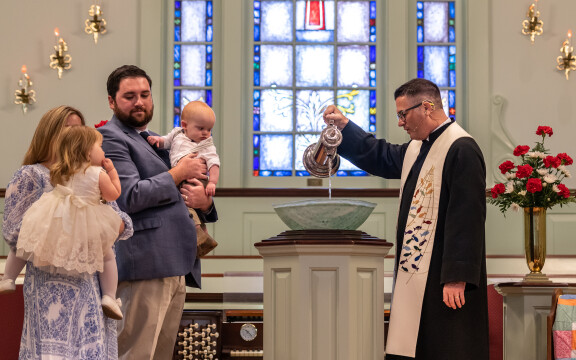
Baptism is the sign and seal of incorporation into Christ. Jesus through his own baptism identified himself with sinners in order to fulfill all righteousness. Jesus in his own baptism was attested Son by the Father and was anointed with the Holy Spirit to undertake the way of the servant manifested in his suffering, death, and resurrection. Jesus the risen Lord assured his followers of his continuing presence and power and commissioned them, "Go therefore and make disciples of all nations, baptizing them in the name of the Father and of the Son and of the Holy Spirit, and teaching them to obey everything that I have commanded you. And remember, I am with you always to the end of the age" (Matt. 28:19, NRSV). The disciples were empowered by the outpouring of the Spirit to undertake a life of service and to be an inclusive worshiping community, sharing life in which love, justice, and mercy abounded. Dying and Rising in Baptism In Baptism, we participate in Jesus' death and resurrection. In Baptism, we die to what separates us from God and are raised to newness of life in Christ. Baptism points us back to the grace of God expressed in Jesus Christ, who died for us and who was raised for us. Baptism points us forward to that same Christ who will fulfill God's purpose in God's promised future. Covenant and the Water of Baptism In Baptism, the Holy Spirit binds the Church in covenant to its Creator and Lord. The water of Baptism symbolizes the waters of Creation, of the Flood, and of the Exodus from Egypt. Thus, the water of Baptism links us to the goodness of God's creation and to the grace of God's covenants with Noah and Israel. Prophets of Israel, amidst the failure of their own generation to honor God's covenant, called for justice to roll down like waters and righteousness like an everfiowing stream. (Amos 5:24) They envisioned a fresh expression of God's grace and of creation's goodness -- a new covenant accompanied by the sprinkling of cleansing water. In his ministry, Jesus offered the gift of living water. So, Baptism is the sign and seal of God's grace and covenant in Christ. Inclusion in the Covenant of Grace As circumcision was the sign and synbol of inclusion in God's grace ard covenant
with Israel, so Baptism is the sign and symbol of inclusion in God's grace and covenant
with the Church. As an identifying mark, Baptism signifies
The body of Christ is one, and Baptism is the bond of unity in Christ. As they are united with Christ through faith, Baptism is the bond of unity in Christ. As they are united with Christ through faith, Baptism unites the people of God with each other and with the church of every time and place. Barriers of race, gender, status, and age are to be transcended. Barriers of nationality, history, and practice are to be overcome. Baptism: Grace, Repentance, Commissioning Baptism enacts and seals what the Word proclaims: God's redeeming grace offered to all people. Baptism is God's gift of grace and also God's summons to respond to that grace. Baptism calls to repentance, to faithfulness, and to discipleship. Baptism gives the church its identity and commissions the church for ministry to the world. Sign and Seal of God's Faithfulness God's faithfulness signified in Baptism is constant and sure, even when human faithfulness to God is not. Baptism is received only once. The efficacy of Baptism is not tied to the moment when it is administered, for Baptism signifies the beginning of life in Christ, not its completion. God's grace works steadily, calling to repentance and newness of life. God's faithfulness needs no renewal. Human faithfulness to God needs repeated renewal. Baptism calls for decision at every subsequent stage of life's way, both for those whose Baptism attends their profession of faith and for those who are nurtured from childhood within the family of faith. "One Baptism": Its Meanings a. Both believers and their children are included in God's covenant love. Children of believers are to be baptized without undue delay, but without undue haste. Baptism, whether administered to those who profess their faith or to those presented for Baptism as children, is one and the same Sacrament. b. The Baptism of children witnesses to the truth that God's love claims people before they are able to respond in faith. c. The Baptism of those who enter the covenant upon their own profession of faith witnesses to the truth that God's gift of grace calls for fulfillment in a response of faithfulness. Remembering One's Baptism Baptism is received only once. There are many times in worship, however, when believers acknowledge the grace of God continually at work. As they participate in the celebration of another's Baptism, as they experience the sustaining nurture of the Lord's Supper, and as they reaffirm the commitments made at Baptism, they confess their ongoing need of God's grace and pledge new their obedience to God's covenant in Christ. One Body, One Baptism As there is one body, there is one Baptism. (Eph. 4:4-6) The Presbyterian Church (U.S.A.) recognizes all Baptisms with water in the name of the Father, of the Son, and of the Holy Spirit adnimistered by other Christian churches. Responsibility for Baptism a. For reasons of order, Baptism shall be authorized by the session, administered
by a minister of the Word and Sacrament, or commissioned lay pastor when invited
by the session and authorized by the presbytery, and accompanied by the reading
and proclaiming of the Word. (G-11.0103p; W-3.3602-.3608) Baptism is celibrated
in a service of public worship. Extraordinary circumstances may call for the administration
of Baptism apart from the worship of the whole congregation. In such cases care should be taken that
b. By Chaplains and Others: A governing body may also authorize the celebration of the Sacrament of Baptism by chaplains or other ministers serving in hospitals, prisons, schools, or other institutions where the governing body has an authorized ministry or an institutional witness, by chaplains ministering to members of the armed forces and their families, and by ministers engaged in new church development under the jurisdiction of the governing body. In all such cases of Baptism, the minister of the Word and Sacrament shall take responsibility that the newly baptized person is enrolled as a member of a particular church. Such enrollment may be arranged in advance in consultation with the session of the church, or the governing body may provide that any such newly baptized member shall be enrolled in absentia as a member of a particular church designated by the governing body and under its jurisdiction or upon the roll help by the governing body until a new church is organized. Session Responsibility The session's responsibilities for Baptism are
b. admining to Baptism children of believers, after appropriate instruction and discussion with the parent(s) or one(s) rightly exercising parental responsibility, acquainting them with the significance of what God is doing in this act and with the special responsibilities on parents and congregations for nurturing the baptized person in the Christian life; c. admining to Baptism, after appropriate instruction and examination, those not yet baptized who come making public their personal profession of faith; d. placing all baptized persons on the appropriate roll as members of the congregation; e. making certain that those baptized are nurtured in understanding the meaning of Baptism, of the Lord's Supper, and of their interrelation, and that they are surrounded by Christian encouragement and support. (G-10.OlO2b, d, e; G-10.0302; W-2.3011) Church Responsibility The congregation as a whole, on behalf of the Church universal, assumes responsibility for nurturing the baptized person in the Christian life. In exercising this ministry, the session may designate certain members of the congregation as representatives of the church charged with special responsibility for nurture. For any person who is being baptized, sponsor(s) may be appointed by the session in consultation with those desiring Baptism for themselves or for their children and given the specific role of nurturing the baptized person. (W-6.2001; W-6.2005) Parental Responsibility When a child is being presented for Baptism, ordinarilythe parent(s) or one(s) rightly exercising parental responsibility shall be an active member of the congregation. Those presenting children for Baptism shall promise to provide nurture and guidance within the community of faith until the child is ready to make a personal profession of faith and assume the responsibility of active church membership. (W-4.2002; W-4.2003) The session may also consider a request for the baptism of a child from a Christian parent who is an active member of another congregation. If the session approves such a request, it shall consult with the governing body of the other congregation and shall notify them when the Sacrament has been admimstered. |